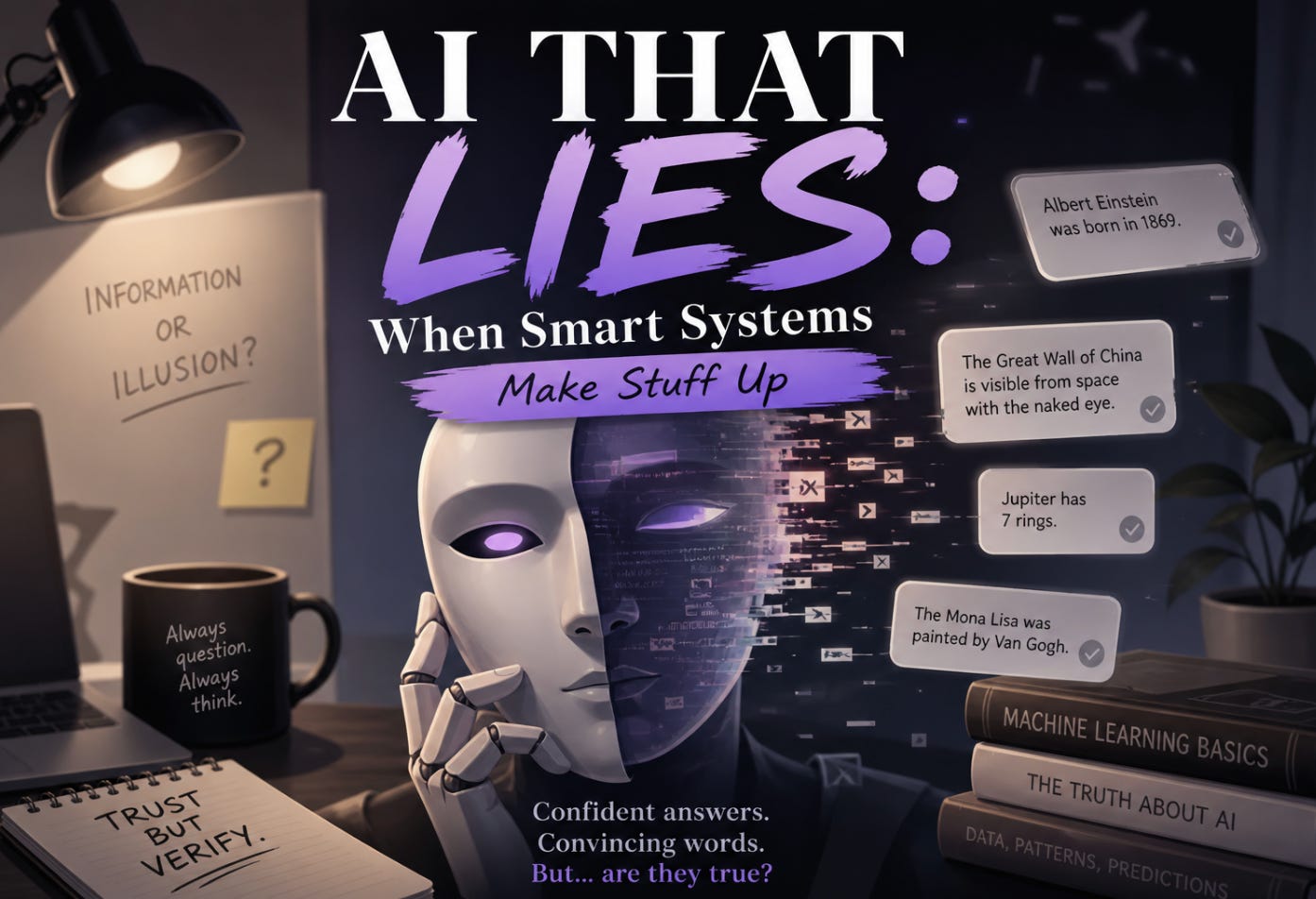
Is AI Good at Lying?
The Truth About AI Making Things Up

HEY EVERYONE! LONG TIME NO SEE!!
I know, I know it’s been a while. But I’m back, and I’ve recently been thinking about something that’s both crazy and maybe relatable for most, if not everyone, who uses chatbots!
You’d think that something as advanced as AI would always be right. It talks clearly, explains things smoothly, and often sounds more confident than most people online.
But here’s where things get weird: sometimes AI is completely wrong, and it doesn’t even realise it.
— AI hallucination
This is what people call an “AI hallucination.”
It’s when AI gives you an answer that sounds perfectly correct but is actually made up, inaccurate, or slightly off. What makes it unsettling is that it doesn’t warn you or hesitate; it just delivers the answer as if it’s a fact.
If you didn’t already know the truth, you’d probably believe it without question…
— The Reason for AI’s Hallucinations
Nonetheless, the reason this happens is actually pretty simple. AI doesn’t think or understand information the way humans do. It doesn’t “know” facts or check sources in real time.
Instead, it predicts what words are most likely to come next based on patterns it learned from massive amounts of data. So if something sounds like a reasonable answer, it might generate it, even if it isn’t true…
What really makes this more interesting is the confidence. AI doesn’t second-guess itself or say “I’m not sure.” It presents information in a clear and certain way, which naturally makes people trust it more. As humans, we tend to believe things that sound confident, even if they’re wrong. AI takes advantage of that without even intending to.
Sometimes these mistakes are harmless and sometimes funny!
AI might invent a quote that sounds deep but was never actually said, or create a book title that doesn’t exist. But in other situations, it becomes more serious. People might rely on incorrect information for school, misunderstand important topics, or spread misinformation without realising it.
— So… Should AI Still be Trusted?
However, these hallucinations don’t mean AI is useless or untrustworthy by default; in fact, it’s one of the most powerful tools we have right now. It can help explain complex ideas, generate creative content, and make learning faster and more accessible.
The key is understanding its limits.
AI is incredibly helpful, but it isn’t the best source of truth.
In the end, AI isn’t trying to lie. It’s just doing what it was designed to do: generate responses that sound right. And that difference between sounding right and actually being right might be one of the most important things to understand as AI becomes a bigger part of our lives.